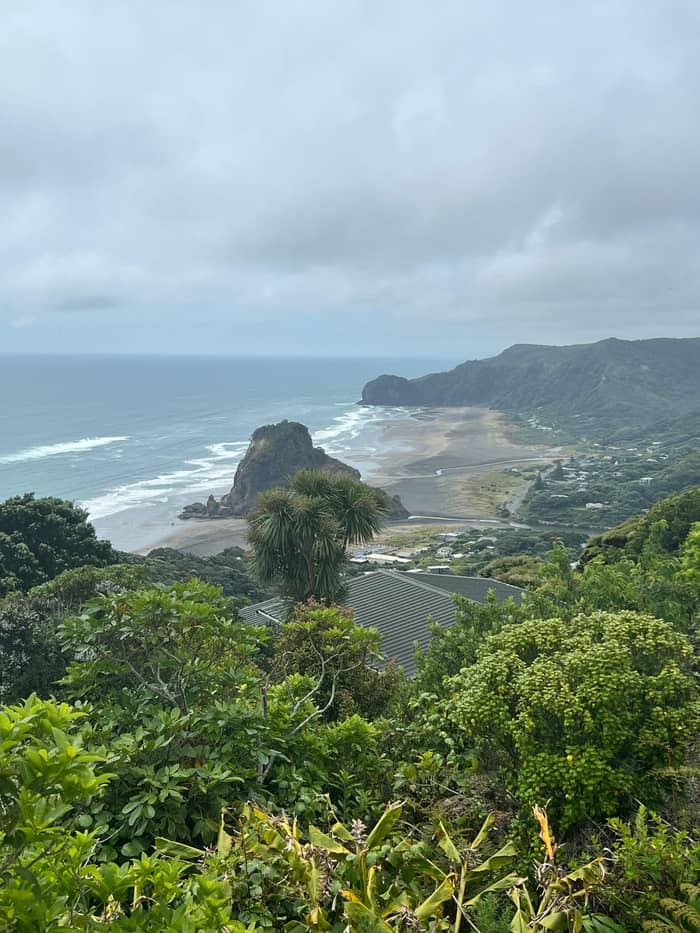
Village beach
Piha
Village, surf club, Lion Rock
- SandBlack volcanic grit
- LandmarkLion Rock
- SwimPatrolled area in summer
Deciding made easy
Two taps to the black sand
Say how long you have and how you like to travel, and a matching listing appears with its from-price.
The one for you
from $118
It lasts 5 hours with pickup, and its labels include walking on Piha's black sand.
The one for you
from $173
It lasts 8.5 hours with pickup and adds city sights and Arataki to Piha.
The one for you
from $188
A private group for 7 hours, with Karekare Falls and Lion Rock.
The one for you
from $103
It lasts 7 hours with a set-menu lunch and the Muriwai gannet colony.
The Piha beach black sand is iron-rich volcanic grit of the kind NIWA says travels up the west coast from Taranaki. Here is what it is made of, why the pale grains are missing, how a magnet proves it and how to keep your feet unburnt.
Editorial team, pihabeachtour.click · Updated November 8, 2026 · ~8 min read
Quick look
Stand at the top of the beach on a sunny afternoon and the sand looks like crushed charcoal with a metallic glint. That glint is the clue. NIWA, the national water and atmosphere research institute, explains that the dark sand along the North Island's west coast is titanomagnetite, a mineral that combines titanium and iron.1 It is not ash, soot or wet mud, and it does not wash out of your towel any faster than pale sand does.
Color on a beach is borrowed from the rock that made it. The same NIWA scientists point out that a sand's color, its weight and the size of its grains all follow from the source material.6 Northland shows the contrast well: the white sand at Parengarenga is quartz, and the golden beaches of Golden Bay take their tone from weathered iron oxide in granite.7 Piha sits on a coast fed by volcanoes, and the beach shows it.
So when people ask why Piha beach sand is black, the honest answer is a pairing. Part of the story is what arrives, a heavy, iron-rich grain from volcanic rock. The rest is what leaves, as the surf keeps sorting the beach and carrying the lighter grains away. Both are worth knowing before you walk down from the car park, and both explain why the beach looks different from the golden sand you may know from the east coast.
Sand compared
| Beach | Sand color | What makes it |
|---|---|---|
| Piha and the west coast | Black | Titanomagnetite, titanium and iron1 |
| Parengarenga, Northland | White | Quartz7 |
| Golden Bay | Golden | Iron oxide weathered from granite7 |
| North of Auckland, Bay of Plenty | Creamy | Feldspar and quartz, slow to wear down14 |
Color, weight and grain size follow the source rock, as NIWA explains.6
NIWA says the iron in the black sand of the North Island's west coast began inside Mount Taranaki, the volcano far to the south, and is swept north along the shore as far as North Cape, a trip it gives as about 400 km that grinds each grain rounder and finer.2 Rivers bring the eroded rock to the sea, and from there the coast becomes a conveyor belt. Nobody shovels it onto Piha; the ocean delivers it, grain by grain, and keeps rearranging what it has already dropped.
The engine of that conveyor is the swell. NIWA's coastal scientist describes prevailing waves driving north out of the southern ocean and pushing the sand along a kind of coastal highway, with headlands acting as places where it pauses.9 At the far end the sand collects on Pandora Banks, a set of shoals off North Cape.10 Piha is among those pauses, a beach held between cliffs where part of the moving river of sand rests for a while.
It is the waves, not the tide, that do the heavy lifting: NIWA says tidal currents move very little sand.11 Watch the white water at Piha for a minute and you are watching that process at work, as each broken wave lifts grains, rolls them and drops them a little further along. The beach you photograph is never quite the same sand as the beach someone photographed last year, and after a winter of storms the shape of the shore can look noticeably different.
How far the sand reaches
Black sand beaches are not only about the dark mineral arriving. They are also about the light minerals being removed. NIWA explains that the very high wave energy on the west coast winnows out quartz and feldspar, which are less dense and paler, and leaves the heavier black ironsand behind.3 It is the same idea as panning for gold: shake the pan hard enough and the heavy grains stay put.
This sorting happens along a long stretch of coast. NIWA's ocean minerals report puts the ironsand belt at 450 kilometers, running from Whanganui up to the Kaipara Harbour.12 The dark minerals in it include titanomagnetite, magnetite and ilmenite, all eroded from the volcanic rocks of Taranaki.8 Piha sits on that same stretch of coast, which is why the neighboring beaches to the north and south share its color and its weight underfoot.
Look closely and you will often see streaks: a thin black film on top of slightly paler sand, or dark ripples left in the shallows as a wave runs back. Those patterns are the sorting caught in the act, heavier grains settling first where the water slows. On a calm day they can look painted on. After a big swell the whole upper beach may be a shade darker, because the waves have had more energy to sift it.
Black sand beaches
Village beach
Village, surf club, Lion Rock
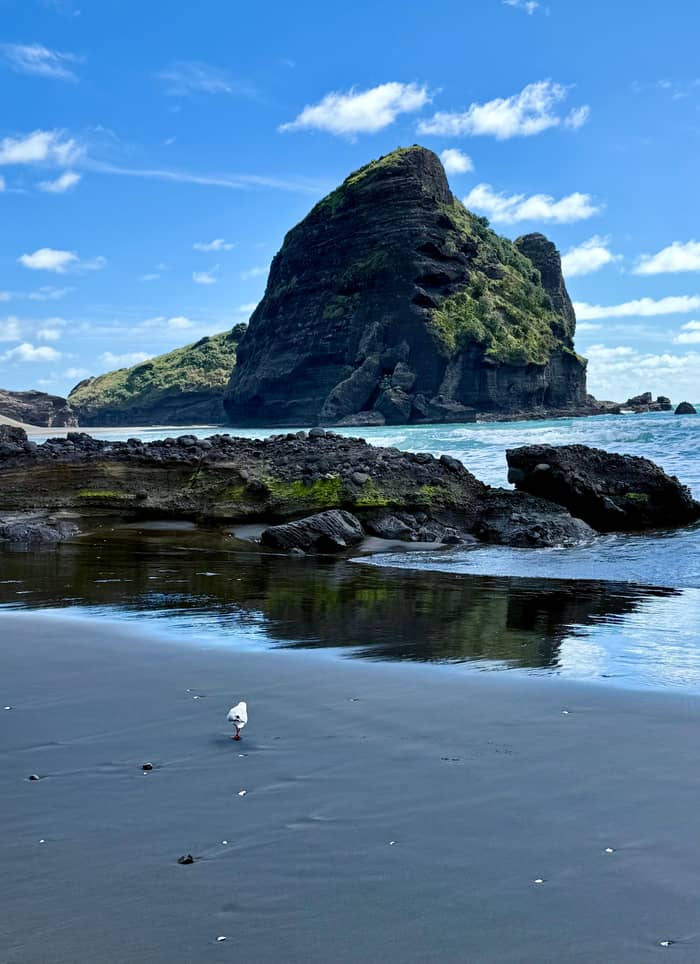
Dune beach
Dunes and a stream
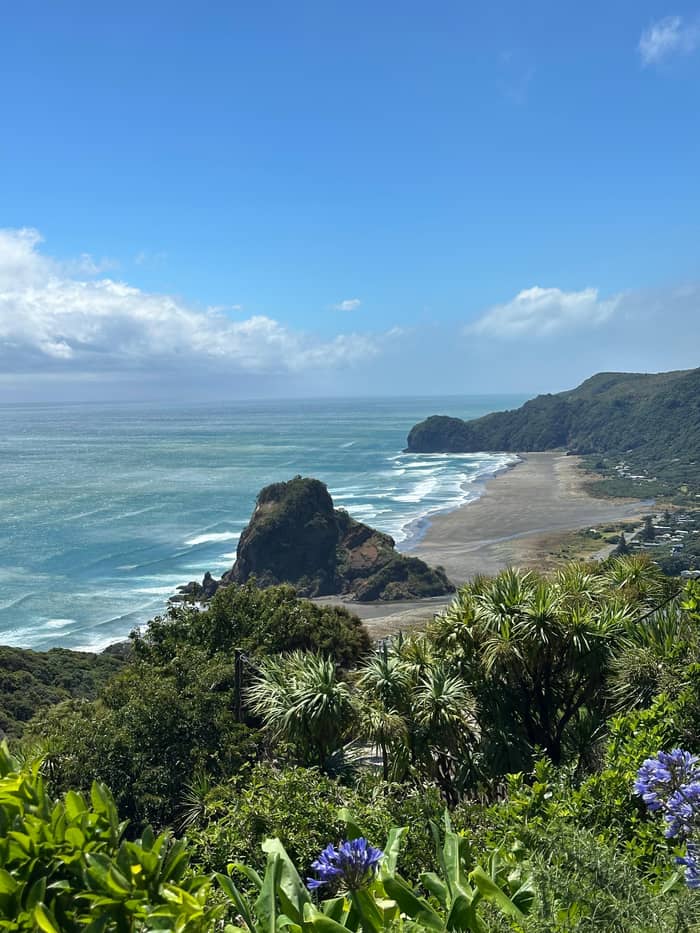
Bush beach
Bush, cliffs and a waterfall
You do not need a laboratory to prove there is iron underfoot. NIWA notes that geologists check the iron content of a sample with a magnet on the end of a pencil.4 A small fridge magnet sealed inside a zip-lock bag does the same job on the beach: drag it through dry black sand, lift it, and a beard of dark grains clings to the plastic. Open the bag over the sand and they fall straight back.
Seen up close, the grains are tiny. NIWA defines sand as grains between 0.06 mm and 2 mm across, and the long trip north leaves these ones rounded and fine.17,2 A cheap hand lens shows the mix: mostly glossy black grains, with a scatter of clear or pale fragments that the waves have not yet removed. It makes a quick experiment for children while the adults watch the surf, and it turns a geology lesson into something they will remember.
The iron is real enough to be mined elsewhere. NIWA says iron-rich sand has been dug for decades from old dunes at Taharoa and Waikato North Head and used for steel making at home and abroad.18 Treat Piha's sand as part of the place: test it, photograph it, and leave it on the beach for the next visitor. Shake out shoes and bags before you leave, since the fine grains travel home in every seam and pocket.
A grain's journey
Inside the volcano
Crystals of iron-rich mineral form in volcanic rock.8
Erosion
Weathering and rivers carry the grains to the sea.8
On the move
Southern swell drives the sand along the coast.9
Sorting
Strong surf winnows out quartz and feldspar.3
Resting
Beaches between headlands act as pauses on the way.9
The end
The journey ends in shoals off North Cape.10
Dark sand absorbs sunlight, and on a still summer day the upper beach can be painful to cross barefoot. Surf Life Saving New Zealand reports that west coast lifeguards remind visitors how hot the sand gets, and asks people to bring suitable footwear for the walk down to the water.5 It lists hot sand among the common summer hazards that are rarely dangerous but can be very painful.19
The fix is simple. Keep jandals or water shoes on until you reach the damp sand near the waterline, and leave them where you can find them again rather than at the top of the beach. Carry small children across the dry stretch. Dogs feel it too, so think about the time of day if your dog comes along. A towel laid on the sand cools quickly in the shade of a windbreak, and the hard wet sand by the water stays comfortable all day.
Early morning and the last part of the afternoon are the kindest times for bare feet, and they are also when the sand looks its best. Low sun turns the black surface into a mirror after each wave, and Lion Rock throws long shadows across it. If you plan photographs, those hours give you texture in the sand and color in the sky, and you will not be hopping between patches of shade.
Video
Out There Learning on YouTube · The video waits until you tap play to load.
Waves do most of the work moving sand; tidal currents do very little.
Ready for the beach
Piha is not the only dark beach west of Auckland. Tourism New Zealand lists Whatipu, Karekare, Piha, Te Henga (Bethells) and Muriwai together as the wild west coast beaches.20 Bethells is quieter than Piha but has the same black sand, according to the regional tourism agency.15 Muriwai to the north runs for 60 km of windswept coast.13 Each has its own character, but the iron in the sand is shared.
What sets the Piha black sand beach apart is the setting rather than the sand itself. Tourism New Zealand describes its volcanic black sand framed by rugged cliffs and headlands, facing the dark and unpredictable Tasman Sea.21 In the middle of the beach stands Lion Rock, formed from the eroded neck of an ancient volcano, which splits the shore into Piha and North Piha.22 Local volcanic rock and far-traveled sand meet in the same view.
If you want to compare the beaches yourself, the dark sand is the constant and the mood changes. Muriwai feels open and endless, Bethells sits behind dunes and a stream, and Karekare is enclosed by bush and cliffs. Piha has the village, the surf club and the rock. All of them share the same Tasman swell, so read the beach warnings at each beach, swim only where it is flagged, and keep footwear handy on sunny days.
Without a car, a guided trip is the simplest way to stand on the sand. The tour this site sells lasts 5 hours from Auckland, includes pickup, and lists a walk on Piha's black sand alongside bush tracks in the Waitakere Ranges rainforest and a kiwi-style afternoon tea. It costs from $118, and it can be cancelled free up to 24 hours ahead. Not every hotel is on the pickup list, so check yours when you book.
Other listings change the balance of the day. A longer premium small-group tour of 8.5 hours pairs Auckland's city sights with an afternoon on the bush tracks, Piha Beach and the Arataki Visitors Centre, from $173. A private tour of 7 hours adds Karekare Falls and Lion Rock to Piha, from $188. A private car also lets you linger on the sand at the hour you choose, which helps if photographs are the point of the trip.
If Muriwai's black sand appeals more, a 7-hour tour with lunch at a brewery visits Muriwai Beach and its gannet colony instead of Piha, from $103. Whichever you choose, the sand behaves the same: bring footwear, a small magnet in a bag if you want to test it, and something to wipe your feet before you climb back into the vehicle. Expect a few dark grains to ride around in the car for days afterwards.
FAQ
NIWA says the material comes from Mount Taranaki and is swept north along the coast toward North Cape, about 400 km.2
Tourism New Zealand's Piha page opens by calling it a scenic black-sand surf beach west of Auckland.23
West coast lifeguards warn the sand can get extremely hot and ask beachgoers to bring footwear.5
The 5-hour tour from Auckland includes pickup and a walk on Piha's black sand, from $118.
Tourism New Zealand groups them with Piha as Auckland's wild west coast beaches.20
Sources
Black sand, rainforest or the surf? A real person answers here.