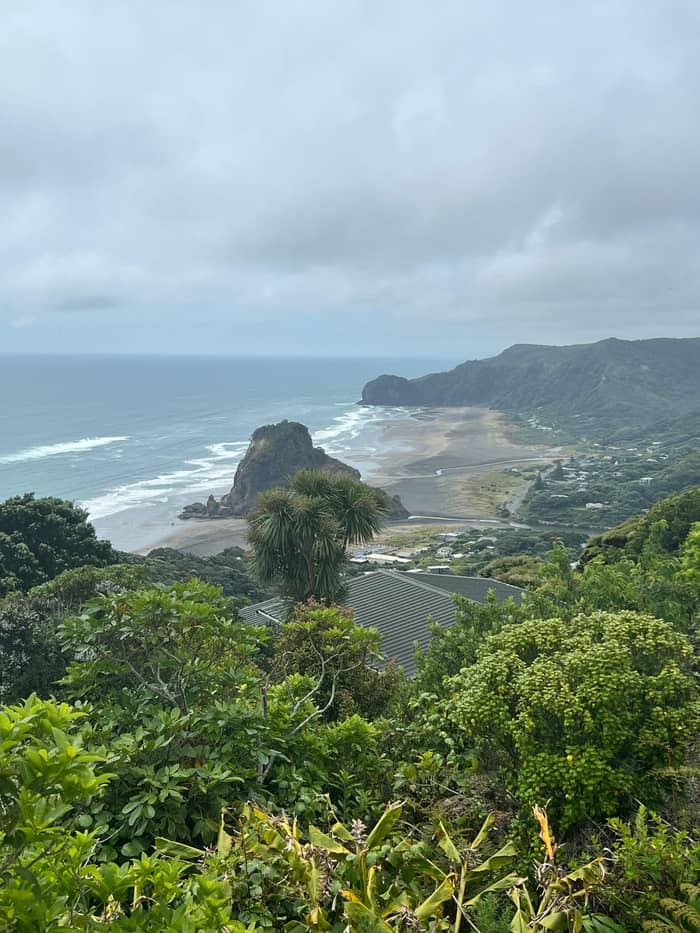
Listen high up
Tūī
Nectar feeder and mimic
- Look forWhite throat tuft
- SoundSong with clicks
- FoodNectar
Interactive tick list
Checklist · 7 points
Check things off as you go; your progress is kept on this device.
0 / 7 ready
You are all set. Only the date is left to choose for your afternoon in the ranges and on the sand.
Save a placeBefore the road drops to Piha it crosses the Waitakere Ranges, a rainforest of kauri, nīkau palms and tree ferns. This guide explains what grows there, which birds you will hear, and the kauri rules every walker follows.
Editorial team, pihabeachtour.click · Updated November 8, 2026 · ~7 min read
Quick look
The hills you cross on the way to Piha are the Waitakere Ranges, and they are far bigger than they look from the city. Tourism New Zealand sizes the regional park at 16,000 hectares of rainforest and coast, and puts it a 40-minute drive from central Auckland.1,7 Drive Scenic Drive on a clear morning and the bush runs unbroken from the ridge to the Tasman.
The forest has a name older than the park. Auckland Council refers to it as Te Wao Nui-a-Tiriwa, the Waitakere Ranges forest, and at Arataki a carved pou speaks of the guardianship of Te Kawerau ā Maki over the Great Forest of Tiriwā.8,9 Knowing that changes how you walk in it: this is a living cultural landscape as much as a nature reserve.
The rainforest near Piha Beach is not jungle in the tropical sense. It is temperate forest, cool and damp, with tall conifers, palms that look out of place this far south, and a thick understorey of ferns. Rain arrives quickly from the Tasman and the canopy holds the moisture, which is why the tracks can be muddy long after a shower has passed and why good shoes matter here.
Know the trees
| Plant | How to spot it | Worth knowing |
|---|---|---|
| Kauri | Tall gray trunk, crown high above | Lives over 2,000 years4 |
| Nīkau | Ringed trunk, long fronds | Only native palm22 |
| Ponga (silver fern) | Silver underside to the fronds | A national symbol23 |
| Mamaku | Very tall tree fern | Up to 20 m19 |
| Wheki | Skirt of dead brown fronds | Hairy koru24 |
Descriptions from the Department of Conservation's native plant pages.25,20
Scenic Drive passes the Arataki Visitor Centre on the way into the ranges. The regional tourism agency gives its address as 300 Scenic Drive, about a 30-minute drive from central Auckland, with free parking.2 Entry is free for everyone.3
You are greeted by an 11m kauri pou carved by members of Te Kawerau ā Maki, depicting the iwi's ancestors.9 Inside, displays cover the forest's plants, birds and history. The center, its exhibitions and the main viewing areas are wheelchair accessible, though the tracks outside vary in difficulty.15 From the deck you look across the ranges toward the Manukau Harbour.
Arataki is also where to ask what is open. The agency suggests checking current track conditions with staff, cleaning footwear at every hygiene station and sticking to open tracks.16 The Beveridge to Arataki Track starts here and leads through mature bush where tūī and bellbirds call, a good short sample of the forest if you are not continuing to the coast.17
The tree that defines this forest is the kauri. The Department of Conservation ranks kauri among the mightiest trees on earth: they top 50 m, reach trunk girths of 16 m and can pass 2,000 years of age.4 Kauri forest once spread over 1.2 million ha of the upper North Island.28 Young trees are straight poles with a narrow cone of branches; mature trees shed their lower limbs and carry a crown high above a clean gray trunk.25
Europeans valued kauri as raw material. DOC explains that sailors prized young trunks for masts and spars, settlers felled mature trees for timber, and kauri gum became essential for varnish and resin products.29,30 The old trees that survive matter all the more for it.
Kauri also shape the ground around them. DOC notes that their long lives and tannin-rich leaves change the soil they grow in, creating their own habitats.31 For scale, the largest remaining kauri, Tane Mahuta in Northland's Waipoua forest, stands 51.5 m high and measures 13.77 m around.18 DOC calls kauri a taonga species for Māori.32
Your forest day
Choose by time, transport and what you want to learn.
If I have a car and an hour
Stop at Arataki
If I want a guide to explain it
Take the beach and rainforest tour
Bush tracks plus Piha, with pickup.
If I am bringing a dog
Keep it on a leash
Or leave it at home, as asked.26
If I want to see giant kauri
Ask at Arataki what is open
The council lists forested areas as closed, with exceptions; check first.10
If I love birds
Walk slowly and listen
Tūī and bellbirds call near Arataki.17
Forest birds
Listen high up
Nectar feeder and mimic
Comes close
Follows walkers
Listen for wings
The native pigeon
The great threat to these trees is a microscopic organism. DOC explains that Phytophthora agathidicida lives in soil, enters kauri through the roots and slowly starves the tree; there is no known cure.36,27 Auckland Council adds that it spreads in a pinhead of mud, and that people are major carriers, along with dogs, pigs and goats.5,37
The iwi Te Kawerau ā Maki responded in December 2017 with a rāhui to protect the forest, and Auckland Council's kauri page lists the forested areas of the ranges, with some exceptions, among its track closures; the page carries no date, so check its map before you go.8,10 Controlled Area Notices under the Biosecurity Act now apply to parts of the ranges.38 On 2 August 2022, 10 national rules came in to limit soil movement and protect kauri roots.11
Regional rules go further: nobody may carry kauri material or soil in or out of the zone that extends three times a kauri's dripline.39 The council treats trees with phosphite, which has to be repeated after five years, and it was treating high priority sites at local parks during the 2025-2026 summer.40,13 Specially trained dogs now help find infected areas.41
Protecting kauri
December 2017
Te Kawerau ā Maki place a rāhui over the forest.8
Closures
Council lists forested areas as closed, with exceptions.10
2 August 2022
10 rules limit soil movement and protect roots.11
2023
Storms damage many west Auckland tracks.12
2025-2026
High priority sites treated during summer.13
October 2026
The council's park projects page is updated.14
The forest's most surprising shapes are its palms. DOC says no palm grows wild further south than the nīkau, and it is the country's sole native palm.22 It usually grows 10-15 m tall, with a ringed trunk and fronds up to 3 m long.20 Research in lowland forest near Auckland found nīkau take 40-50 years to start a trunk and roughly 200 years before they stand 10 m tall.42
A tall nīkau trunk stands for generations of slow growth. Their bright red fruit feed native birds, especially the kererū, and Māori used the leaves to thatch houses and wrap food for cooking.43,44 The tour this site sells names palms and giant tree ferns in its highlights, plus an old kauri.
Ferns fill the gaps. DOC counts about 200 fern species in New Zealand, from 10 m tree ferns to filmy ferns 20 mm long, and about 40% grow nowhere else.21 The ponga, or silver fern, is a national symbol named for the pale underside of its fronds; the mamaku is the tallest tree fern at up to 20 m.23,19 Look for the coiled young fronds, the koru, a shape you will see on everything from logos to carvings.45
Video
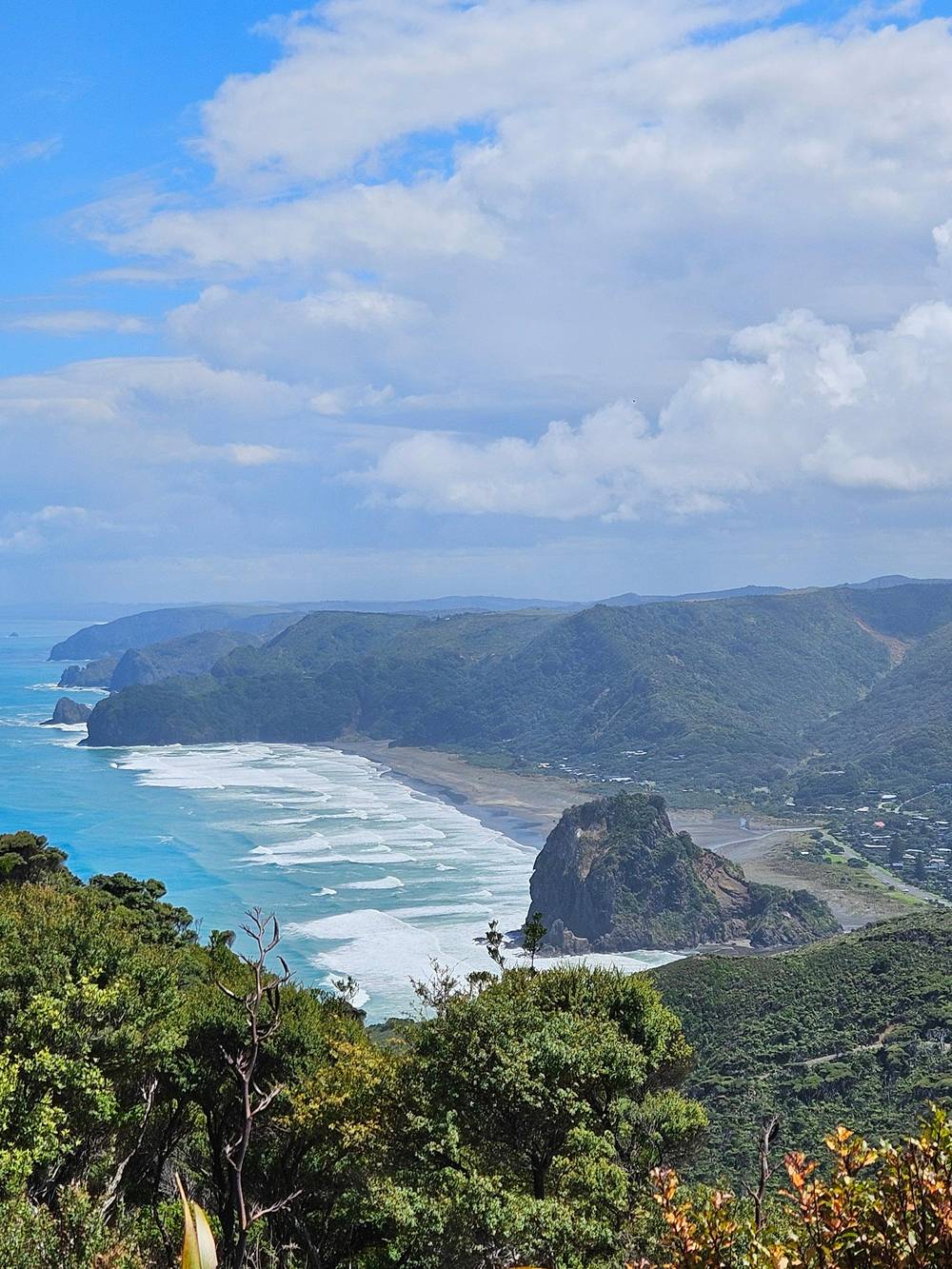
Jason moofang on YouTube · The video waits until you tap play to load.
There is no known cure, but we can help reduce its spread by avoiding any movement of soil around the roots of trees.
Stand still on a forest track and the soundtrack starts. Tūī are unique to New Zealand and feed mainly on nectar; DOC says you can recognize them by the white tuft at the throat and their noisy wingbeats, and they can mimic other sounds.46,47 Their song mixes clear notes with clicks and wheezes, and often comes from high in the canopy.
The bird that often comes close is the fantail. DOC calls it one of the most common native birds on the mainland and notes it often follows people to catch insects disturbed by their footsteps.48,49 If a small bird flits around you with its tail spread, that is a fantail feeding, not a pet.
Listen too for a heavy whoosh overhead. The kererū, the native pigeon, measures up to 51 cm and weighs about 650 g, and the beat of its wings is a distinctive forest sound.50,35 DOC says it is now among the only birds big enough to swallow large fruit and spread their seed, which makes it vital for the forest's future.51
Tourism New Zealand's advice for the ranges is short and clear: remove soil from shoes and gear, use the hygiene stations, stay on tracks so you are not touching the forest floor, and keep dogs on a leash or leave them at home.34,26 Tourism New Zealand says a number of tracks are still temporarily closed because of kauri dieback; its page is undated, so check the council's map before you pick a walk.52,33
At each hygiene station, follow the instructions on the sign to clean soil off your soles, on the way in and on the way out, since soil carried out of a forest can infect the next one. Keep to the boardwalks around big trees to protect their roots. Pack food scraps back out, and keep voices low if you want to hear the birds.
If you would rather have a guide explain the forest as you walk, our featured tour spends 5 hours on the round trip from Auckland, with pickup, pairing bush tracks in the rainforest with Piha's black sand, from $118. A longer 8.5-hour small-group tour adds city sights and the Arataki Visitors Centre, from $173.
FAQ
Tourism New Zealand describes 16,000 hectares of native rainforest and coastline.1
The ranges' rainforest begins on the hills right behind Piha and is a 40-minute drive from the city.7
Kauri dieback spreads in soil; the council's kauri page lists the forested areas, with some exceptions, among its closures (undated).10
In December 2017 the iwi Te Kawerau ā Maki declared a rāhui to shield the forest from kauri dieback.8
The regional tourism agency says admission is free for everyone.3
Tourism New Zealand wants dogs leashed the whole time, or left at home.26
DOC says kauri grow over 50 m tall with girths up to 16 m.4
Sources
Black sand, rainforest or the surf? A real person answers here.